 Ask Doctor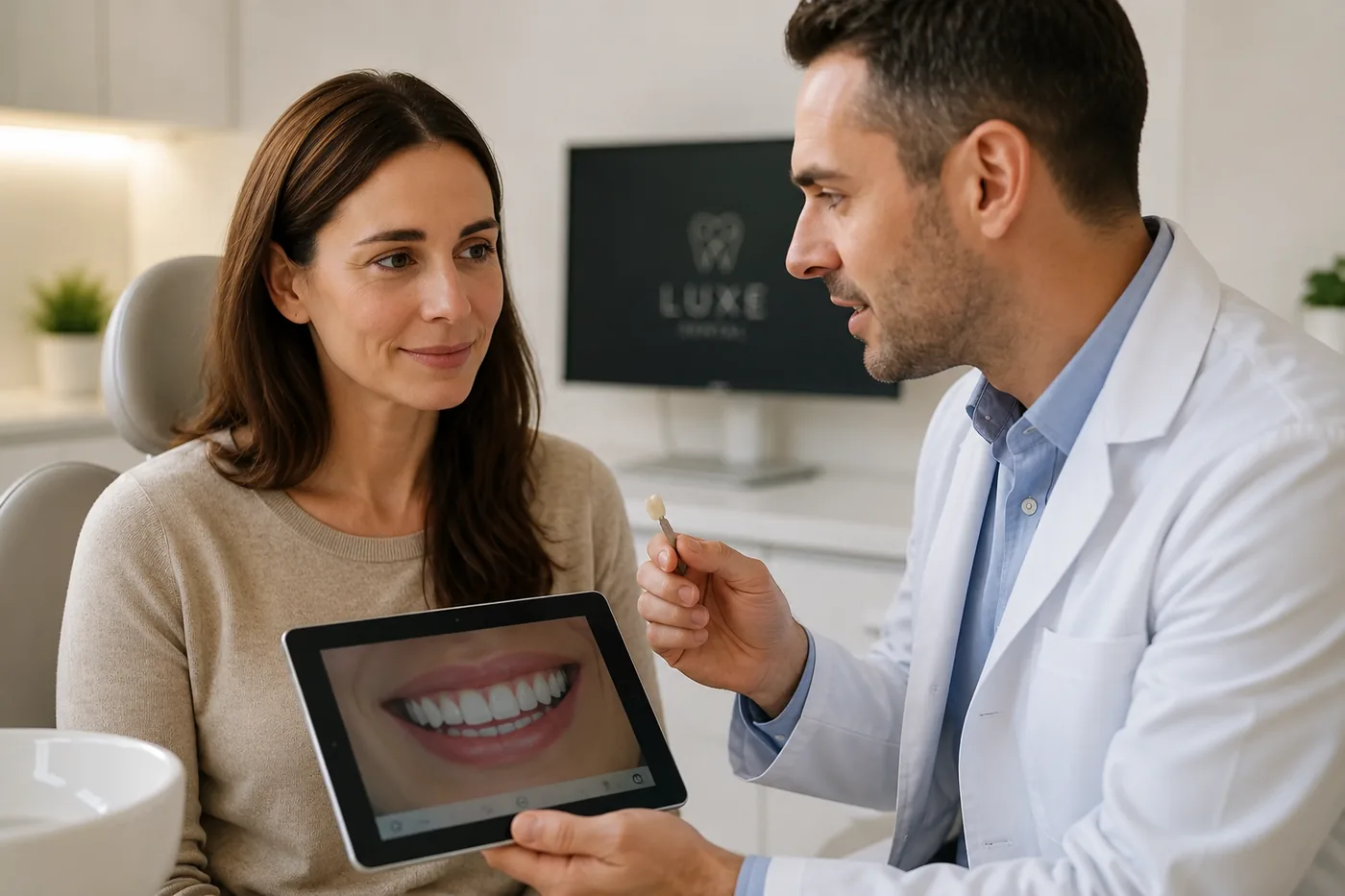
A veneer usually looks bulky, opaque, or unnaturally white for reasons that trace back to the planning stage, not to the porcelain itself. The most common cause is a combination of design choices: ceramic that's thicker than the tooth structure removed for it, a shade selected for maximum brightness rather than a natural gradient of translucency, or proportions that don't quite match the patient's lip line and gum contour. Whether that shows up as a slight bulge along the gum, a flat look across the front teeth, or a shade that reads as chalky under normal light depends on how carefully those variables were matched to the individual face. Confirming exactly which factor is at play usually requires an in-person exam, since photos alone rarely show contour and thickness clearly.
The physics of a thin shell of ceramic
Every veneer is essentially a thin shell of ceramic bonded to the front of a tooth, and how it reads to the eye depends on three interacting variables: thickness, translucency, and how much natural tooth structure was reduced to make room for it. When too little tooth is removed but the plan still calls for full coverage, the lab often has to make the ceramic thicker than ideal just to hide the natural tooth underneath. A thicker veneer tends to scatter light evenly across its surface instead of allowing the layered translucency real enamel has.
Layered ceramic is built to mimic how natural enamel lets some light pass through near the biting edge while staying more opaque near the base. Skip that layering, or rely on a single flat shade applied uniformly, and the result reads as a solid, uniform block of white rather than something that resembles a tooth.
Whiter isn't the same as more natural
A common assumption is that whiter and more opaque is simply the safer outcome, since it feels like it can't be mistaken for anything but "done." In practice, natural teeth are rarely a single flat shade. They tend to be more translucent near the biting edge and slightly warmer near the gumline, with subtle variation between adjacent teeth.
A design built purely around maximum whiteness overrides that variation, and the eye reads a uniform, opaque row of teeth as artificial even when each individual tooth looks clean and bright in isolation. The more accurate goal for a natural-looking result is usually a shade and translucency that complements the surrounding teeth and the patient's complexion, not the single brightest option on the shade guide.
Thickness, shade, and contour, planned together
Before any ceramic is fabricated, a dentist typically works through several design variables together rather than choosing one in isolation. Ceramic thickness is planned against how much natural tooth structure will be prepared, since thickness and translucency are directly linked: too thick, and the veneer looks flat and opaque no matter what shade is chosen.
Shade is selected relative to the patient's complexion and the surrounding natural teeth, not just against a shade guide held up in isolation under office lighting. Contour is planned against the gumline and lower lip line, since a veneer that ends abruptly at the gum or extends too far can look bulky even when the shade itself is well chosen. Getting an unnatural look right usually means recognizing it as one or more of these planning decisions falling out of proportion with the patient's face, rather than a limitation of what porcelain veneers can achieve.
Proportion and facial harmony matter as much as ceramic
Facial harmony plays as much of a role as the ceramic itself. A dentist planning veneers usually considers tooth proportions relative to the width of the smile, how the edges align with the lower lip during speech, and how the gumline frames each tooth. Small adjustments, a slightly rounder edge on one tooth, a fraction of a millimeter less length on another, can be the difference between a smile that looks tailored to the person's face and one that looks like a generic set of teeth placed over it.
This kind of planning typically involves a mock-up or digital smile design reviewed with the patient before any tooth is prepared, so proportions and shade can be adjusted on-screen rather than after the ceramic is already made.
Existing veneers can often be reassessed
If veneers already in place feel too bulky, too white, or poorly proportioned, that's usually a solvable design problem rather than a permanent outcome, though the right fix depends on what's actually driving the look. Sometimes contour alone can be refined by adjusting high spots along the gumline. Other times the underlying issue is thickness or shade built into the ceramic itself, which typically means new veneers designed with different specifications rather than an adjustment to the existing ones.
An in-person evaluation is the only reliable way to tell which situation applies, since photos taken under different lighting can make the same veneer look more or less opaque than it does in a mirror at home.
- The teeth look noticeably brighter or flatter than the rest of the smile in natural daylight
- The edge of the veneer feels thick or ledge-like against the tongue
- The gumline around the veneer looks puffier or less even than neighboring teeth
- The smile looks the same shade of white from every angle, with no lighter or darker areas
Photos in daylight show a visibly different texture compared to the natural teeth nearby
Common questions about natural-looking veneers
Does a more expensive veneer automatically look more natural?
Cost differences usually reflect the lab work and material quality involved, but a careful shade match and thoughtful design plan tend to matter more for a natural appearance than price alone.
Can veneers be made less white after they're placed?
The ceramic's shade can't be changed once it's bonded, so if this is a concern, it's worth discussing shade options thoroughly before the final veneers are fabricated.
Do all veneers eventually look fake over time?
Not from age alone. Well-designed veneers are chosen to hold up visually for years, though gums and surrounding teeth can shift subtly, which is part of why periodic checkups matter.
Is a trial smile or mock-up always available before committing?
Many practices can create a temporary preview or a digital mock-up to review proportions and shade before permanent veneers are made, though availability varies by office.
Are bulky veneers a sign that veneers were the wrong choice for that patient?
Not usually. It typically points to a mismatch in planning, thickness, or shade selection rather than veneers being an unsuitable option for that person's teeth.
A design outcome, not a limit of the material
The bottom line is that a bulky, opaque, or unnaturally white veneer is almost always the result of specific design choices, not evidence that veneers can't look natural. Thickness, translucency, shade, and contour all interact, and getting them right for an individual face is what separates a subtle, tailored result from one that reads as obviously artificial. If an existing veneer feels off, an in-person evaluation is the way to identify which of those factors needs adjusting.
Related reading
Two related topics worth a look: how much natural tooth veneers actually require removing and comparing veneers, bonding, and Invisalign for a small gap. A couple more related reads: whether Invisalign can correct bite alignment and teeth staying yellow after a whitening treatment. For the broader topic list, see the full dental topics index.
Designed for maximum whiteness
- Uniform, flat shade chosen for brightness.
- Thicker ceramic that limits light transmission.
- Little variation between the biting edge and the base of the tooth.
Designed for natural translucency
- Shade shifts subtly from edge to gumline.
- Thickness matched to the available tooth structure.
- Contour planned against the natural gumline and lip line.
A veneer is meant to look like a tooth that happens to be flawless, not like a tooth-shaped piece of porcelain.