 Ask Doctor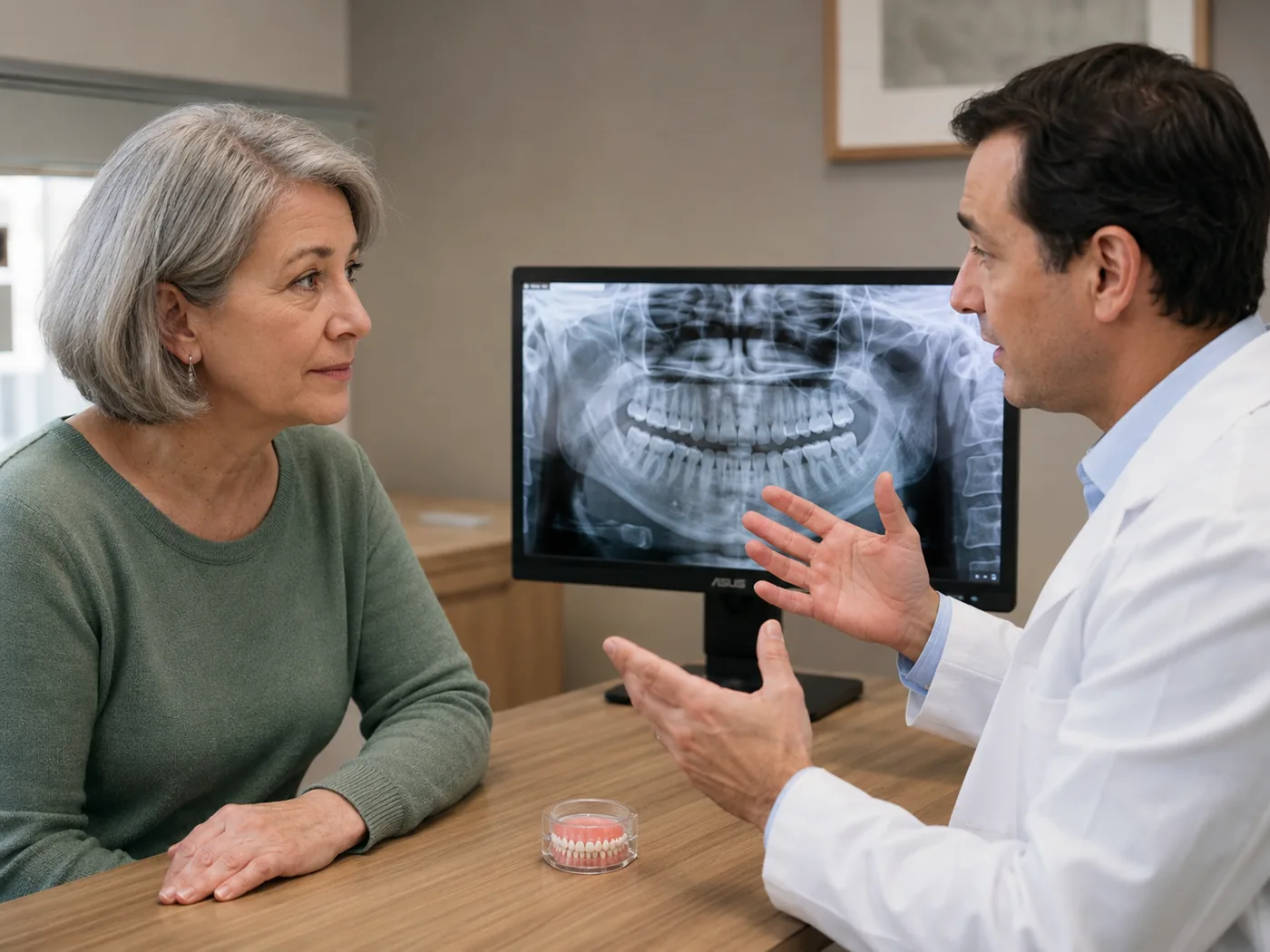
So which one actually protects the bone?
If you're weighing dentures against dental implants, the honest answer is that implants generally do a better job of preserving your jawbone over the years, while a denture resting on the gum tends to let that bone gradually shrink underneath it. But it depends on how many implants are placed, where they sit, and how much bone you already have going into treatment. The factor that changes urgency the most is how much bone has been lost already, since waiting can eventually limit which options remain available. Either way, a real answer for your mouth needs an exam, a scan, and a look at your bite, not just an article.
Why your jawbone reacts differently to each option
Bone stays dense when it's regularly loaded with force, the same way a bone in your arm or leg stays strong with use. When a natural tooth root is present, chewing sends that force straight down into the jawbone through the root, which signals the body to keep rebuilding and maintaining density in that spot.
A dental implant post fuses directly to the bone through a process called osseointegration, so it recreates that same pathway. Chewing force travels through the implant into the bone almost the way it did through your original tooth root.
A denture works differently. It sits on top of the gum and the ridge of bone underneath, rather than transmitting force into the bone the way a root does. Without that direct stimulation, the body treats the area as if it no longer needs to maintain that density, and the ridge slowly flattens over years. This is why some longtime denture wearers notice their dentures loosening periodically and needing to be relined or remade, and why the lower face can gradually appear shorter or more sunken over time.
This isn't just a comfort and cost decision
Most patients come in assuming dentures and implants are basically interchangeable, differing mainly in how they feel and what they cost upfront. I understand why. Both replace missing teeth, both can look natural, and both let you eat and speak again.
What that assumption misses is the structural side. One option tends to preserve the shape of your jaw and face over years, and the other, in most cases, gradually allows it to change. That difference often doesn't show up in the first year or two. It shows up later, as facial contours shift subtly, as a denture that fit well starts feeling loose, or as remaining bone becomes too thin for implants to be placed comfortably without additional grafting.
Framing this only as comfort versus price skips the part of the decision that has the longest-lasting consequences.
How I actually assess your bone before recommending either one
Before I suggest dentures or implants for anyone, I need to see what's actually there. A panoramic X-ray gives a first look at overall bone height and the position of nerves and sinuses. For implant planning specifically, I'll often order a cone beam CT scan, which builds a three dimensional picture of the jaw so I can measure bone width and density at the exact spot an implant would go, not just estimate it from a flat image.
That scan tells me whether there's enough bone volume to place an implant as is, whether a bone graft would be needed first to build up a thin ridge, or whether, in cases of more advanced bone loss, an implant supported denture that uses fewer implants to anchor a removable appliance is the more realistic path. Patients are sometimes surprised that this evaluation happens before we ever discuss which option they'd prefer, but the bone itself often narrows the choice before preference does.
Bone preservation, side by side
Dental implants
- Fuse to the bone and transmit chewing force into it, which helps maintain density at that site for years.
- Requires enough existing bone or a graft first.
- Higher upfront cost and a longer treatment timeline.
Traditional dentures
- Rest on the gum and ridge without loading the bone directly, so the ridge tends to gradually resorb over years.
- Lower upfront cost.
- Fit may need adjusting or relining as the ridge changes shape.
What to do if you're deciding right now
- Ask for a current X-ray or scan of your jawbone, not just a visual exam, before choosing between options.
- Bring up how much bone volume remains in the areas where teeth are missing or will be extracted.
- Ask specifically whether a bone graft would be needed for implants in your case, and what that adds to the timeline.
- If cost is the main barrier to implants, ask about implant supported dentures as a middle option.
If you already wear dentures, ask whether your current fit suggests the ridge has changed since they were made.
Why waiting can quietly change your options
Bone loss under a denture doesn't happen all at once, and it usually isn't painful, which is part of why it goes unnoticed for so long. It happens gradually, often over several years, and it tends to accelerate in the first year or two after a tooth is lost or extracted before slowing to a steadier rate.
The practical concern is that thinner bone eventually makes implant placement more complicated. A ridge that had plenty of width for an implant five years ago may need grafting today. This isn't meant to pressure anyone into a decision. It's simply why I'd rather have this conversation with a patient earlier, while more options are still straightforward, than later, once bone loss has narrowed them.
Implant supported dentures: a middle path worth knowing
Not every patient needs a full set of individual implants to get some of that bone preserving benefit. An implant supported denture anchors a removable appliance onto a small number of implants, usually two to four in the lower jaw. It costs less than replacing every tooth individually, and because those implants still transmit chewing force into the bone at their location, they help slow the resorption pattern seen with a purely tissue supported denture.
It's a genuine middle ground, not a compromise version of "real" implants, and for many patients with existing bone loss it's the most realistic way to combine stability with bone preservation.
Questions patients ask me most about this
Does bone loss from dentures ever reverse on its own? No. Once the ridge resorbs, it doesn't rebuild by itself. Adding implants later, or grafting, can restore some support, but the original bone volume doesn't return without intervention.
Can I switch from dentures to implants later if I change my mind? Often, yes, though the more bone has resorbed, the more likely a graft becomes part of that process. A current scan is the only way to know where you stand.
Do implants ever fail to fuse to the bone? It's uncommon but possible, particularly with certain health conditions, smoking, or insufficient bone density at placement. This is exactly why the pre-treatment scan and evaluation matter.
Is an implant supported denture removable, like a regular denture? Yes, in most designs. It clips onto the implants and can be taken out for cleaning, but it sits far more securely than a denture resting on gum tissue alone.
Will my face shape actually change if I stick with dentures long term? It can, gradually, as the supporting bone thins and the lower facial height shortens. How noticeable that becomes varies a great deal from person to person and depends on how much bone was present to begin with.
The takeaway for your jaw and your smile
Implants tend to preserve jawbone because they transmit chewing force the way a natural root did. Dentures tend to allow gradual bone loss because they don't. Neither fact makes dentures the wrong choice for every patient. Cost, health history, and how much bone remains all shape what's realistic for you, and an implant supported denture can bridge much of that gap. What matters most is going into the decision with a current scan in hand and a clear picture of what each option means for your bone, not just for the next few years, but for the ones after that.
Related reading
Two related topics worth a look: when bleeding gums are a warning sign and how long All-on-X implants typically last. A couple more related reads: ongoing swelling around a dental implant and swelling or bleeding around an implant. For the broader topic list, see the full dental topics index.
The choice that looks similar in the mirror today can look very different on a scan ten years from now.