 Ask Doctor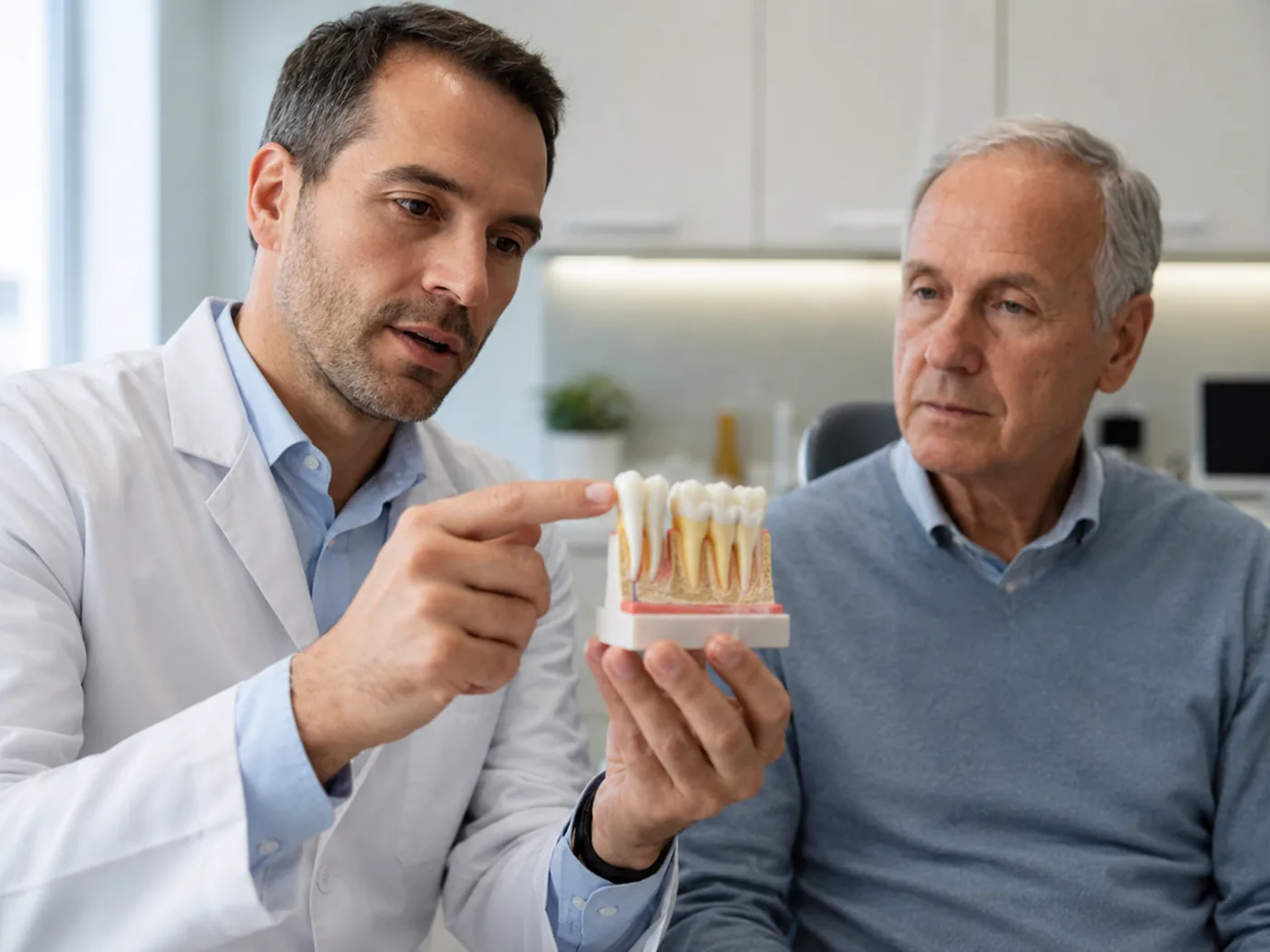
Why food keeps landing in the same spot
If food wedges into the same spot around your implant meal after meal, the cause is usually physical, not behavioral. It comes down to how tightly the crown touches the tooth next to it, how the crown emerges from the gum, and how that surrounding gum tissue is shaped. A contact point that has opened up even slightly, or a crown profile that doesn't match the natural curve of the gum, will trap food in the same place every time no matter how carefully you clean. How urgent this is depends mostly on whether the gum around the implant looks and feels normal or shows ongoing irritation. Confirming exactly which factor is at play, and correcting it, generally requires an in-person exam rather than more effort at home.
The gap that opens after the crown is already placed
An implant crown is usually fitted with a snug contact against the neighboring tooth at the time it's placed. The problem is that natural teeth aren't perfectly still. They sit in a periodontal ligament that allows a tiny amount of shock-absorbing movement, and over months and years that can let a natural tooth drift a fraction of a millimeter. An implant doesn't move that way. It's fused directly to bone, so it stays exactly where it was placed. When the neighboring tooth shifts even slightly and the implant doesn't follow, the once-snug contact can open into a gap, and that gap becomes a reliable food trap.
The crown's shape near the gumline matters just as much. This area is called the emergence profile, essentially how the crown widens as it comes up out of the gum tissue. If that curve is too narrow, too flat, or doesn't match the contour of the gum around it, it can leave a small shelf or pocket where food settles instead of being pushed clear when you chew.
It's rarely a flossing problem
Patients often assume they simply aren't flossing well enough, and end up flossing harder, more often, or with a sharper technique to try to force the problem away. In practice, the actual cause is frequently the shape or fit of the crown itself, not the effort behind the cleaning. Floss can only remove what's already loose. It can't close a contact that has opened up, and it can't reshape a crown that doesn't sit against the gum the way it should. If you've genuinely improved your technique and food still lands in the exact same spot every time, that's a strong sign the issue is structural rather than a habit worth blaming yourself for.
Checking the contact, the profile, and the gum together
A dentist evaluating a recurring food trap will typically check the tightness of the contact between the crown and the neighboring teeth, often by testing how much resistance floss meets as it passes through. Next comes a look at the crown's emergence profile, the exact shape of the crown as it exits the gum, since a profile that's too narrow or misshapen can trap food independently of the contact point. Finally, the surrounding gum contour itself gets assessed, because gum tissue can settle or change shape in the months after an implant is restored, and that change can open small pockets that weren't there initially. Taken together, these checks usually point to a design or spacing issue rather than anything about how the area has been cleaned at home.
Managing it until it's evaluated
While you're waiting for an appointment, a few adjustments can reduce daily frustration without making anything worse.
- Switch to a floss threader, implant-specific floss, or a soft interdental brush sized to the gap rather than forcing regular floss through repeatedly
- Try a water flosser on a gentle setting aimed directly at the trap spot after meals
- Note exactly when and where the trapping happens, such as with certain foods or on one particular side, to describe precisely at your visit
- Avoid repeatedly forcing floss or a pick into the same spot with more pressure, since that can irritate the gum without solving the underlying gap
Signs the gum needs attention sooner
Occasional food trapping on its own usually isn't an emergency. What changes the urgency is what the surrounding gum tissue is doing. Gum that stays pink, firm, and comfortable between meals is a different situation than gum that's persistently tender, puffy, or bleeds when you brush or floss near the implant. Ongoing irritation from trapped food can, over time, contribute to inflammation around the implant, so tenderness, bad taste, or bleeding that doesn't settle down within a few days is worth reporting rather than waiting out. Any swelling, spreading discomfort, or looseness in the implant itself should be evaluated promptly rather than managed at home.
Options a dentist may consider
The fix depends on which factor is actually causing the trap. A contact that's only slightly loose can sometimes be corrected by adjusting or polishing the crown's contact surface without remaking anything. A more significant gap, or a crown whose emergence profile genuinely doesn't match the gum, may call for remaking the crown with corrected contours. In some cases, minor reshaping of the gum tissue itself helps the contour settle into a shape that sheds food naturally. For a smaller gap that doesn't fully resolve with an adjustment, your dentist may simply recommend a specific interdental cleaning tool as an ongoing maintenance solution rather than further intervention.
Common questions about implant food traps
Can a water flosser fix a food trap by itself? It can make daily cleaning easier and reduce leftover debris, but it won't close a gap or reshape a crown. It's a management tool, not a structural fix.
Is it normal for the contact next to an implant to loosen over time? Yes, a small amount of change is common because neighboring natural teeth can shift slightly while the implant stays fixed in place. That's exactly why a contact that felt fine at first can start trapping food later.
Does a loose contact always mean the crown has to be replaced? Not necessarily. Some contacts can be adjusted or polished without a full remake. Whether that's enough depends on how much the contact has opened.
Can gum shape alone cause trapping even if the contact still feels tight? Yes. An emergence profile or gum contour issue can trap food independently of how snug the side contact is, which is why both get checked separately during an exam.
How soon should I bring this up with my dentist? If it's just occasional and the gum looks normal, mentioning it at your next routine visit is usually fine. If there's tenderness, bleeding, or swelling that doesn't settle, it's worth calling sooner.
What to take away from this
The bottom line is that a food trap that keeps showing up in the same place around an implant is almost always about the physical fit of the crown, its contact with the neighboring tooth, its emergence profile, and the surrounding gum contour, rather than a gap in your cleaning routine. Adjusting your home care can help manage it in the short term, but an in-person exam is what actually identifies which of these factors is responsible and what correction will resolve it for good.
Related reading
Related reading that comes up often: swelling or bleeding around an implant, along with how long All-on-X implants typically last. It's also worth checking ongoing swelling around a dental implant and how dentures and implants differ for jawbone preservation. For the broader topic list, see the full dental topics index.
Loose or open contact
- The crown and neighboring tooth no longer touch tightly.
- Floss slides through with little resistance, and food packs in during chewing.
Emergence profile or gum contour issue
- The crown's shape at the gumline creates a shelf or dip.
- Food collects there even when the side contact itself still feels reasonably snug.
A food trap around an implant is usually telling you something about the crown's shape, not about your cleaning habits.